Sunday, March 18, 2012

How To Customize and Add Length to Ready-made Curtains

Ready-made curtain panels can easily be purchased at most stores. They are an inexpensive way to help complete a room’s look. However, many ready-made curtains come in standard lengths, which don’t always work in your home. Adding a fabric to any curtain panel will not only add length to the panel, but will also add your own personal touch to them. Select a contrasting or coordinating fabric, solid or patterned, to go with the curtain panels you already have and help achieve the look you want and create your own custom curtains!

Materials Needed: Store bought curtain panels, fabric of your choice, fusible fabric iron on, scissors, yardstick, iron, and curtain hardware
1. Before you get started, measure where your current curtain panels hang and then measure how much additional fabric you will need to add in order for them to just skim the floor. Typically, curtains should be mounted about halfway between the top of the window frame and the ceiling. However, with higher ceilings measure the distance above the window frame to the ceiling and then mount the curtains about 1/3 of that distance.
2. Shop for your fabric! The fabric can be added to either the top or the bottom of your existing panels. The directions given are for adding fabric to the bottom of the panels. As a rule of thumb, the darker fabric should be at the bottom to keep the curtains visually balanced.
3. Lay out your ready-made panels flat and then lay your selected fabric over these panels so that you can copy the width. Add a couple of inches at each edge so that you can fold over for a nice seam. Measure and cut the desired length as well, also leaving a few inches to fold over.
4. Place a strip of the fusible iron about an inch from the edge of the selected fabric, fold over about a half-inch of fabric, and iron the fabric together to create a hem. Do this all the way down each side of the fabric length-wise only.
5. Once the length of both sides of the fabric has been hemmed, position the panel onto the ready-made panel with about an inch of overlap. Once positioned, place your strip of iron-on between the fabrics and iron for about 10 seconds on each strip until you’ve adhered all of the fabric to the panel.
6. Once the fabric has been ironed onto the panel you should have a couple inches of fabric left over on each side. Cut off additional fabric on the ends so that about one inch remains
7. Again, lay down a strip of iron on fusible tape about an inch from the edge of the fabric, fold the edge over, and then iron to fuse fabric together. Do this on both ends and this will finalize all hemming.
8. Attach your new longer curtain panels to the curtain hardware and enjoy your custom curtains!

Sunday, March 11, 2012

How To Arrange a Bookcase

Bookcases can be a blessing and a curse to the overall design of a room. A blessing because, when done properly, will add beauty and comfort to a room. A curse because, what is the “proper way?” Here are a few tips and tricks to arranging a beautiful bookcase and containing the clutter:

1. Take account of what you have. If you don’t have a lot of books, plan on putting the books you have on the bottom shelves and leave the upper shelves for accessories. Bookcases should visually be heavier on the bottom and lighter on the top.

2. Think about how you’ll use the bookcase. Arranging the books by genre, subject, or author may be the most useful. However, if the bookcase will be more of a visual piece, then arranging the books by color looks great. You can also do a combination of these techniques. Whatever is most useful to you and looks good!

3. Start placing your books. Put your best looking books at eye level and try to hide the most ragged ones. Remove the dust covers (unless they are collectable) to display the books in all thier gorgeous glory. Sometimes books have beautiful leather and gold embossing which really add beauty and warmth to the bookcase.

4. Paperbacks need a place too. Mix these in with hardbacks and don’t group too many of these together because they tend to all be a similar small size which does not fill up a shelf very well. Be mindful of book sizes when placing books on the shelves together and try not to put really tall books next to short ones.

5. Mix up the orientation of the books. Place some upright and lay others on their side. These stacks of books can serve as ‘bookends’ to the rows.

6. Don’t over crowd the shelves, leave a little bit of breathing room on each shelf. And never pile excess books, magazines, or papers on top of a row of books.

7. Accessorize with some non-book items: picture frames and other knick-knacks work great as bookends, sitting on top of a stacked pile of books, and breaking up a long row of books. You can also hang a framed artwork over some of the shelves if you have enough space (or too much!)

8. Put telephone books, loose papers or magazines out of site. Use nice looking magazine files or storage boxes to hide these items.

Wednesday, February 1, 2012

How to Throw a Last Minute and Fabulous Super Bowl Party!


So you just decided to have some friends over for the big game… or your house was voted as the place to be for the most important day of football. Either way, you've got to put together a fabulous football party in a short amount of time. Here are some quick tips to be on the winning team this year!
Ready, set, go!


Get your roster and game time set! Study your playing field!
Invite a fun and diverse group of friends and tell them all to arrive an hour before kick off time. But before that, make sure you have enough seats and space for everyone on your list. Since this party revolves around watching TV, you don't want anyone to be left without a seat. Then think about your layout... where will the food and drinks go? Make sure that they won't interfere with the view to the TV!

Get your game plan ready!
Decide if you will be providing all of the food or if this will be a team effort (aka, pot luck).
If it’s a pot luck you should plan on the main dishes so that you are sure to be covered. Then send a quick request to your guests and ask them to tell you what they'll be bringing. Fill in any gaps as you hear back.
If you'll be providing all the food, keep in mind that most people will still show up with something in hand. So have some extra bowls or platters ready. For some great recipes, check these out!


Support your fans!
By having a few other things going on during the game you are sure to involve all of your guests. But to keep the party from becoming too segregated into footballers and non, make sure the activities are still about the game… here are a few ideas:
* Add in some extra excitement to the game by having some fun bets ready. Depending on your crowd, make them as silly or serious as you want! Keep it light though, no big money bets allowed!
* Make some quick and easy team flags or pom-poms for your guests to cheer on their team. They’ll get in the spirit faster than you can say “go team!”
* Have a football bingo game ready for those that aren't super excited about the Super Bowl. Keeping an eye out for a crazy face painter, a green wig, or something else eccentric will keep them interested and involved in the party.
* Remember the days of elementary school? A paper football game is fun too! Or if you have the space, go outside and play a quick game!

Just remember not to force your guests into participating in these activities or let them interfere with the game watching... some people really just want to watch the game (really!).

Be a good sport!
Most importantly relax and have fun, if you are then your guests will be too!

Hopefully these tips will help you and your guests have a SUPER time!

Cheers!
Ellenor

Saturday, January 14, 2012

Get Organized!

I recently had the pleasure of organizing the home office of a good friend. Now, when I say "pleasure" you much understand something about me... I am an organizational super fan! I was taught by the best, the organizational goddess herself... my mother. She molded me from a young age, even buying me an instructional "How to" children's book on organizing. At first I resisted... I fought it most of my life actually. It wasn't until I moved away that I realized (like most things she had taught me) that she was right.

I have come to learn that the skill of organization is a learned behavior. If not taught and practiced, it will not come. Enter my good friend...

My friend has many wonderful and outstanding qualities, organization is just not one of them. She works from home and was recently promoted, giving her many additional responsibilities and a large amount of paperwork to keep track of. With this promotion, she quickly realized that her "system" (or lack there of) would not support her increased workload. Knowing of my supreme skills (ahem, ahem) and of my crazy enjoyment of organizing, she came to me for help.

When I asked her about her current "system," I was horrified to learn about the large basket where she aimlessly threw everything. I nearly cried. I agreed to get to work immediately.

Below, you can read through how I was able to take her home office from scary to organized, and how you can do the same.

What you'll need:
A day of your time
Ample space on the floor
Lots and lots of Post-its
Pen for Labeling (I'm obsessed with Sharpies, especially the colored ones)
Paper Clips
Binder Clips (or as my friend adorably called them, "munchies")
Stapler

1. Grab your scary stack of unorganized papers and sit on the floor with plenty of space around you.
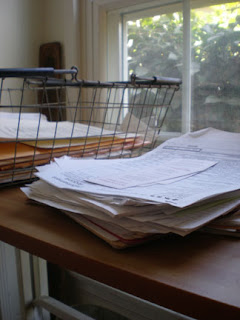
2. Begin by going through the scary pile each item at a time. Sort everything into different groups by making piles on the floor. To start off, be as specific as you can with these groupings... its better to have more piles than less. Once you see what you have, and how much space each group takes up, then you can decide what groupings can be combined, or further separated.
3. Stick a post-it on the top of each group/pile as you go labeling what it is.
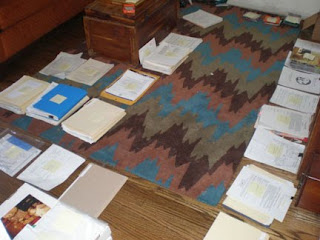
4. Now that you are surrounded by much less frightening piles, go to your bills, invoices, etc... and put them in chronological order. Think about how you will file and how you will want to access these papers in the future... do you want the most recent date in the front or back? Choose, and then be consistent!!! Do this with all chronological groupings.
5. Take note of the papers as you go through them. Are there duplicates that you don't need? Toss them! Is the receipt separated from the invoice? Staple them together! Condense and organize!
6. Now that you have a good sense of how large or small each pile is you can begin to combine or separate as necessary. Be careful not to make any one pile too general. Otherwise this will become a catchall of random papers. For example, my husband (before he met me of course) had files of "important Papers" (which had everything from his birth certificate to an oil change printout) and "Old Receipts" (which ranged from 2001 to now... Every. Single. Receipt.)
7. Make new post-it labels for those final piles.
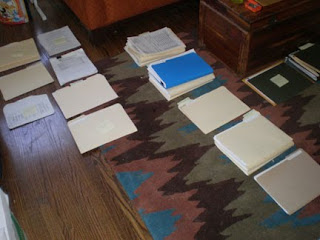
8. Survey what you have and make a shopping list of what you need to put all these piles away. Think of how you will use your new and fabulous organizational system. For storage, do you prefer 3-ring binders? File cabinet with hanging files? Letter boxes or trays? Magazine holders? Consider these storage options in conjunction with how often you will need to access the contents and their importance. Look at the amount of groups/piles you have and the space that you have to work with. Its ok to combine different storage systems. For this project, we decided to use a binder for important documents, a few boxes for media and pamphlets, a file cabinet for most, and a open file box for those most accessed papers/files. We went a step further by color coding some folders for the different phases of a project. For example, pending, researched, expired, rejected, and accepted.
9. Shop! Purchase supplies that you need to immediately organize and put away the piles on your floor as well as back up supplies for when you need to expand. I've found that if you don't have these supplies handy, chances are that you'll start scary piles again and your organizational system will fall apart!
10. Splurge! Indulge yourself with some pretty files and organizational tools for the things that will sit on your desk or that you will use most often. If you are excited about it, then you are more likely to use it!
11. Back at home, start putting away your piles. Everything is already separated so this should be pretty easy. As you are putting things away, think again about how you will use it... do you want your credit card statements very accessible, or can they go near the back?
12. Use your post-its to label the new hanging files, boxes, etc, instead of writing directly on the labels provided. Once everything is put away, this will make it easier for last minute changes.
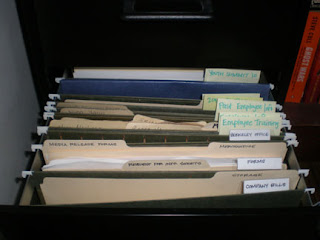
13. Now that everything is put away and you can see your floor again, survey the space that you have created. Does it suit you? Can you keep up with it? If no, move things around and make some changes!
14. Satisfied? Good! Now, remove your post-its and start writing or printing out your labels. Have fun with these, no need to be formal with your labels! Use color, stylized writing, or phrases that you like... for example, for our color coded files mentioned above, instead of using "rejected" we wrote "not now!" to put a positive spin on it (and to remind her to check in with them later). I have a letter tray at home labeled "crap to do" where I put bills to be paid that month, forms that need to be filled out, or anything else that needs my attention when I sit down to my desk. Have fun, but be clear enough to know what you're talking about later!
15. Last but not least, my most important tip! Allow yourself a "To be filed" basket or tray that is easily accessible. This allows you to be "bad" every now and then for those times when you are in a rush of just don't feel like it. BUT leave yourself (or make yourself) go through this at least once a week to separate and file away whats in it. Otherwise, you'll have to start all over again!

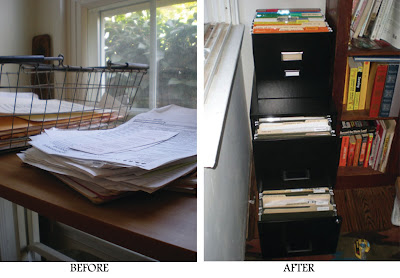
Whew! The hardest part is getting started and going through that scary pile. Once you do this, I hope that you'll find it's easier to keep up with than you think. Hopefully, like myself and my friend, you'll also find that its a bit addictive! Now that she has an organized home office (with pretty files!) she went on by herself to organize her husband's desk and their shared files! I'm so proud :)

Happy organizing!
Ellenor

Friday, November 18, 2011

Holiday Dinnerware

I cant help it, each year I have new ideas for a fun and different winter holiday table setting. If it were up to me, I would have hundreds of dinner sets to choose from in my cabinets each year. Unfortunately, the financial ramifications of such a dream are absurd. Not to mention the storage would be impossible! This is what makes our job so wonderful. I can live vicariously through all our clients. We are currently preparing a few different tablescapes and below are some of my favorite holiday dinnerware sets! For those of you like myself who cannot buy new plates each winter, I highly recommend the Anthropologie Monochrome Mosaic Dinnerware. You can use these every year but completely change the look of your table by the accessories you use. From top to bottom: Sacred Bird Dinnerware, Ralph Lauren Kilgour Plates, Monochrome Mosaic Dinnerware, Iittala's Taika featured in My Barn Owl Blog


Thursday, November 3, 2011

Book Review: Katie Ridder, Rooms

After having this book in my possession, I can’t imagine that my design library would ever be complete without Katie Ridder’s Rooms, sitting on my shelf.

Since bringing this beauty home I have been engulfed in the design euphoria it provides and finding inspiration on every page. Heather Smith MacIsaac wonderfully explains Katie’s methods and design theories through her writing, and Eric Piasecki’s photographs are just as beautiful as the designs he captures. As you read through you feel like you are in each of these gorgeous rooms and speaking with the talented designer herself.

"Dining rooms typically come to life in the evening, when the lights are low ... During the day, they are rooms we mostly pass by or glimpse from another. For that very reason they can handle color-and lots of it."

"Family rooms should invite gathering and stand up to the accumulations that come with an active life."

Katie Ridder Interior Design and Decoration opened its doors in 1995 and has been creating rooms that are full of color, glamour, and real life ever since. Being a mom of three herself, Katie is focused on making rooms that are practical, sophisticated, and full of life. “No matter how lavish a project, no matter its style and degree of sophistication, it remains accessible, family friendly, absolutely inviting, and subtly practical.”

"Color begets color in Katie's studies and family rooms. For furnishings to hold their own against a backdrop of a strong hue, they must have strength in form, boldness of pattern, or some other mark of distinction."

"From cozy and colorful to spacious and bright, Katie's studies and family rooms are inviting yet always hard working spaces."

Before providing us all with the gift of her designs, Katie Ridder worked as an editor at House & Garden and House Beautiful. Her work as an editor must have helped her learn and explore her own design talents because she came out creating designs that are addictive to the eye. There are layers to each of Katie’s designs. The lively color and patterns, the blend of styles, and unique craftsmanship and details are all combined beautifully to create “rooms that are not only pretty and welcoming, they are comfortable and thoughtful.”

"... a bedroom should feel like a sanctuary, consistently comfortable and pleasurably restful. That doesn't mean that it should slip into design somnolence."

"A successful living room beckons you to explore, then invites you to stay awhile."

"Powder rooms, because they are stand-alone spaces hidden behind a door, are places to be a little extravagant, with decoration or material or both."

The book Rooms is not only inspiring and aesthetically pleasing, it is informative as well! Katie’s tidbits such as “Anatomy of a Full-Length Curtain,” “The Ideal Dining Chair,” and "What Every Entry Needs" are very helpful as are her chapters on details. It’s these pieces of advice and guidance that Katie Ridder provides that show off what a pro she really is.

"As much as color distinguishes Katie's work, it is the attention she lavishes on details that elevates her interiors to the level of couture."

Thank you, Katie Ridder, for inspiring me with everything you do! And everyone, I recommend you buy this book right away!

Until next time,

Ellenor

Friday, October 28, 2011

Turn an Outfit Into a Room: Urban Chic

All the designers on last night's Project Runway Season 9 finale did an amazing job. Each of the designer's collections were thoughtfully designed and amazingly constructed, making for a huge impact coming down the the runway!
While there were pieces from each collection that I wanted hanging in my closet right away, Kimberly Goldson's elevated urban girl collection won me over completely. From piece to piece I was in awe. I thought it was a 'ready to wear' collection and I was ready to wear it! I loved the rich colors, the fine fabrics, and the sophisticated yet sexy silhouettes.

If this collection were turned into a room, I bet it would look something like this...